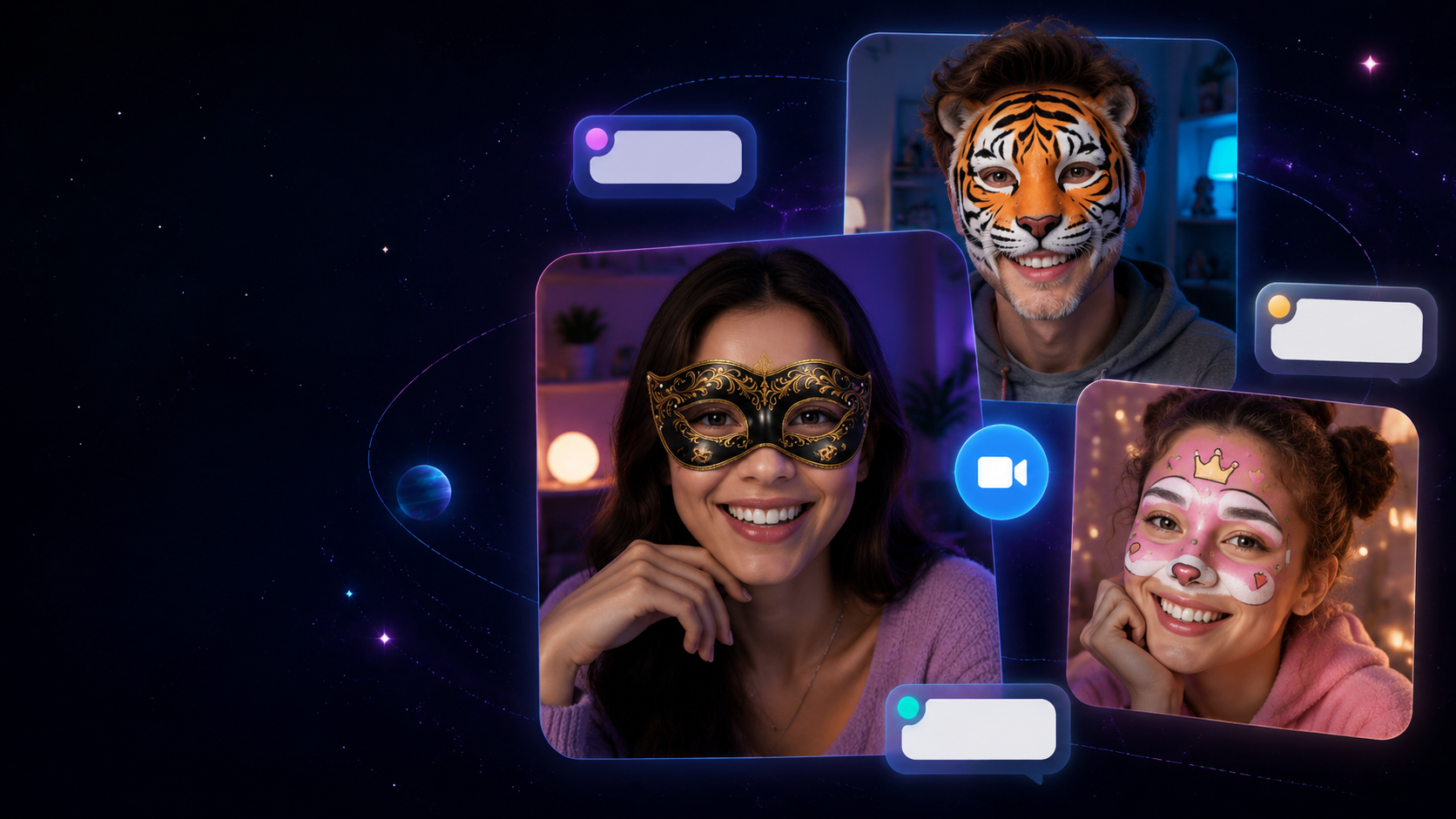
A first video call with a stranger is one of the most exposed moments on the internet. Your face is on screen, in real time, to someone you have never met. There is no filter, no undo, no time to compose yourself. For a lot of people, that exposure is exactly why they never start.
Masked video is a small idea with a big effect: keep the call, but cover the face with a pixel mask. It sounds trivial — how much can a mask change? More than you would guess. The mask changes who feels able to join the call, what happens during it, and what people take with them when it ends.
The problem with raw video
Standard video chat on a stranger app has a built-in pressure curve. The moment the camera turns on, you are being evaluated. Not just your words — your face, your room, your lighting, your reaction speed. The other person is doing the same math. Both of you know it.
This creates a filtering effect that has nothing to do with conversation. People who look "good enough" on camera stay. People who do not — who are tired, who are older, who are in a messy room, who are just having a bad day — leave. The app loses them before the conversation even starts.
The deeper issue is what raw video does to the conversation itself. When your face is fully visible, you spend mental energy managing it. You worry about how you look when you laugh, whether you are smiling enough, whether the other person finds you attractive. None of this helps you actually talk.
What a mask actually does
A pixel mask is not anonymity in the technical sense. It is a visual buffer. It says: "You are seeing me, but you are not seeing all of me, and that is on purpose."
This buffer does three things.
1. It lowers the entry cost. People who would never turn on a camera for a stranger will turn on a masked camera. The mask removes the "am I presentable?" check that kills most video calls before they begin.
2. It shifts attention to voice. When faces are covered, voice becomes the main channel. People start listening more carefully. They notice tone, pacing, the way someone laughs. A masked call is often a better conversation than an unmasked one, because neither side is distracted by appearance.
3. It removes the appearance trap. On a raw video call, the conversation is secretly about looks. On a masked call, the conversation is about the conversation. You cannot judge too quickly, so you have to actually listen.
What the mask does not do
A mask is not a guarantee of safety. It does not stop someone from recording the call (any video call can be screen-recorded). It does not protect you from someone who is determined to be cruel. It is a soft layer, not a hard wall.
What it does is shift the default. On a raw video app, the default is "exposed unless you hide". On a masked app, the default is "buffered unless you choose to show more". That shift changes who feels welcome.
When the mask should come off
The interesting design question is what happens after the first few minutes. Some people want the mask to stay on forever. Others want to drop it once they trust the person. The right answer is not to decide for them.
A good masked video system lets both people keep their mask as long as they want, and lets either person drop theirs without forcing the other. This is why mask removal should always be mutual, not a reward you unlock. The moment dropping the mask becomes a "next step" that the app pushes, the safety value of the mask collapses.
Masked video is not about hiding
The goal of a pixel mask is not anonymity for its own sake. It is to make the first minute survivable. Most stranger conversations die in that first minute, killed by exposure, judgment, and the silent pressure of being watched. The mask buys both people a little space to find out if there is actually a conversation worth having.
Once that conversation exists, the mask can stay or go. But without it, a lot of those conversations never get to exist at all.